
Yes. A car is safe after a collision repair when the work follows the carmaker's own procedures: the structure gets measured and pulled back to spec, the parts are right for that vehicle, the welds and adhesives are done the way the factory specifies, and every safety sensor is recalibrated and confirmed with a scan. The catch is that most of the steps that make a car safe are steps you'll never see. A shop that skips them can still hand you back a car that looks perfect in the parking lot.
That's the whole game. The paint is the part you notice. The structure and the electronics decide whether the car protects you the next time something goes wrong.
What does "done right" actually mean?
It starts before anyone touches a wrench. We pull the repair procedure for your specific car, by VIN, from the manufacturer. A 2019 Camry and a 2024 Camry can call for different welds, different sectioning points, different parts. The carmaker writes those instructions for a reason, and they change year to year.
Then comes teardown, or what the industry calls blueprinting. We take the damaged area apart far enough to see everything, not just what showed up in the first walk-around. Hidden damage is the rule, not the exception. The bumper cover looks like the whole problem. Behind it sits a cracked radiator support and a bent rail. (You can read the full drop-off-to-pickup repair process here if you want the play-by-play.)
If the structure moved, we measure it. Modern unibodies are built to crumple in a precise pattern so the cabin around you stays intact, and if the measurements come back off by even a few millimeters you've changed how that car folds in the next crash. We pull it to factory spec and verify it on the bench, not by eye.
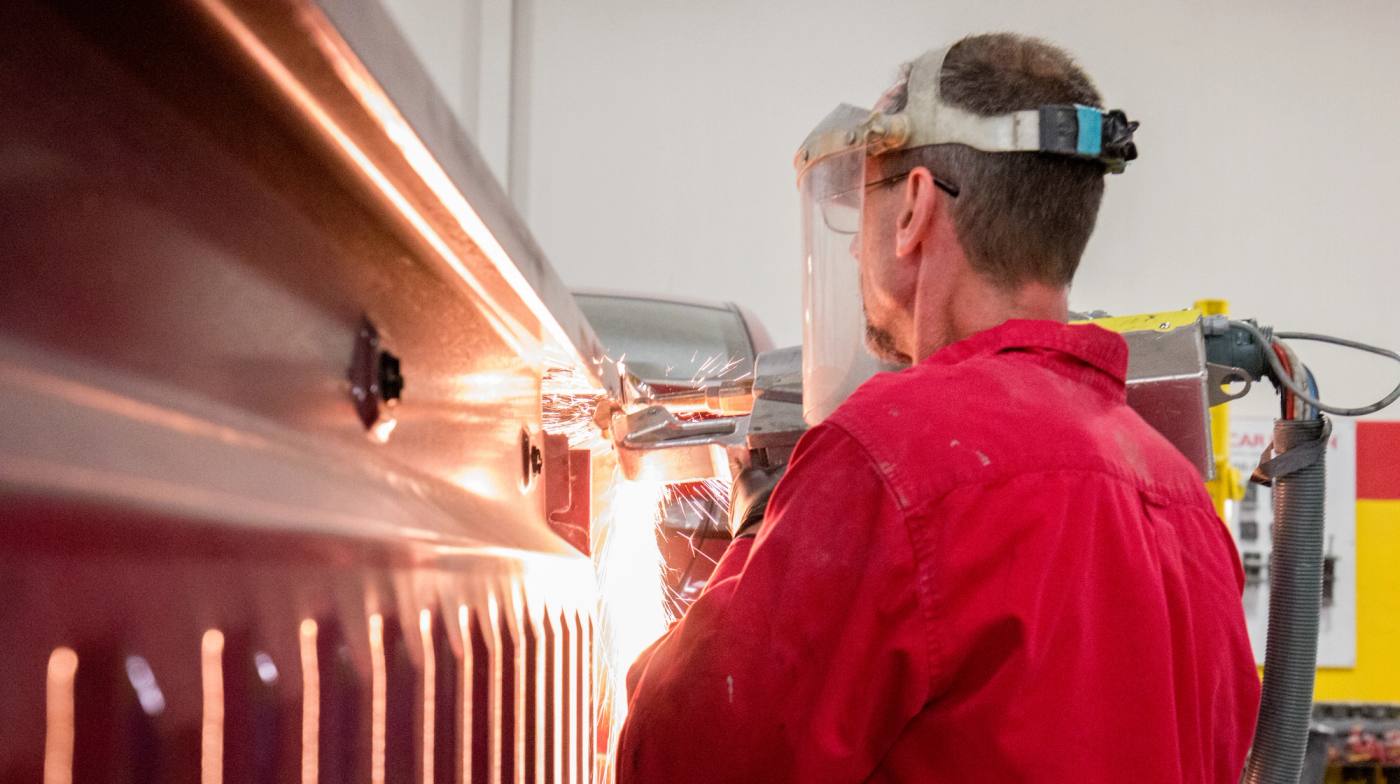
Welds and adhesives matter more than people think. Some panels are welded. Some are bonded with structural adhesive, and some are riveted. Use the wrong one to save time and you weaken the joint exactly where you don't want it weak. Our techs are I-CAR Gold Class, the highest training standard in collision repair, and we hold ASE certifications plus more than 20 manufacturer (OEM) certifications. That training is the difference between a weld that holds and a weld that just looks fine.
What about the electronics and sensors?
This is where a lot of cars get handed back unsafe, and the owner has no idea. Almost every car built in the last several years runs ADAS, which stands for advanced driver assistance systems. Automatic emergency braking, lane-keep assist, blind-spot warning, adaptive cruise. All of it depends on cameras and radar sensors aimed exactly where the factory set them.
Replace a windshield, a bumper, a mirror, or a quarter panel, and you've almost certainly moved or disturbed one of those sensors. A camera aimed two degrees off can read the lane line wrong. Automatic braking that fires late, or doesn't fire at all, is worse than none, because by then you've stopped watching for it. So the car has to be recalibrated after the repair, and on many vehicles that's a precise procedure with targets, a level floor, and the right tooling. We do full ADAS calibration in-house, which means your car doesn't get shipped somewhere else and rushed through on someone else's clock. (We wrote more about why a modern car is a different repair job here.)
Two scans bracket the whole thing. A pre-repair scan reads every fault code the car is throwing before work starts, so nothing hides. A post-repair scan confirms the computer is clean and every system is talking again before we give it back. If your shop can't produce a post-repair scan report, ask why.
Tesla and a lot of the European brands are strict about all of this. We're Tesla certified, and getting there meant proving we follow Tesla's procedures and use their parts and tooling instead of a workaround. A Model 3 is a car you cannot eyeball your way through. The aluminum structure and the sensor suite both have to be done Tesla's way, or it isn't done.
What should I ask my shop for?
Two documents, plus one straight answer. Ask for the post-repair scan report. Ask for written confirmation that the ADAS systems were recalibrated, not just reset. And ask whether they pulled the OEM repair procedure for your VIN.
A shop doing it right won't blink at any of that. We hand it over without being asked. If a place gets cagey, that tells you something.
One more thing worth knowing, and it's your call, not the insurer's. In both Massachusetts and Rhode Island, you choose the shop. An insurance company can suggest one of their network shops, and that's fine, those shops are often good enough. But they can't require it. If you'd rather bring your car to us, that's your right, and we'll handle the insurance billing and claim directly so you're not stuck in the middle. We coordinate towing and have rental cars on site through a third party, and we paint with the PPG system in CMC Italian infrared booths so the color comes back matched and the finish cures right.
What's the warranty, and why does it matter here?
We back every repair with a lifetime warranty. That's the part that should tell you how seriously we take the invisible work. Nobody warranties structural and electronic work for life if they're cutting corners on it. The warranty isn't a sticker. It's us putting our name on the welds and the calibrations you can't see.
A warranty is a backstop, though, not the goal. The goal is that you never need it. A car that was measured, welded, calibrated, and scanned correctly the first time is a car that drives off Bay Street in Fall River and just works, the way it did the morning before the crash.
Want a fast read on damage before you commit to anything? Send us photos through our free online photo estimate and we'll tell you what we're seeing.
Frequently asked questions
Is my car safe to drive after body work?
Yes, if the repair followed the carmaker's procedures, the structure was measured back to spec, the right parts were used, and the safety sensors were recalibrated and confirmed with a post-repair scan. Ask your shop for the scan report and written calibration confirmation.
What is a post-repair scan and why do I need one?
It's a diagnostic read of your car's computers after the repair to confirm every system is working and no fault codes remain. Modern cars depend on electronics for braking and steering assistance, so a clean post-repair scan is how you know those systems came back online correctly.
Does ADAS really need recalibration after a repair?
In most cases, yes. If a sensor or its mounting area was moved, disturbed, or replaced (windshield, bumper, mirror, fenders), the cameras and radar can end up aimed wrong, which throws off automatic braking and lane-keep. Recalibration re-aims them to the factory setting.
Can my insurance company make me use their shop?
No. In Massachusetts and Rhode Island the choice of repair shop is yours. An insurer can suggest a network shop, but you get to pick where your car gets fixed, and we'll handle the claim directly either way.
Why does the lifetime warranty matter for safety?
Because the work that keeps you safe (welds, structural pulls, sensor calibrations) is work you can't inspect yourself. A lifetime warranty on all repairs is the shop standing behind that hidden work for as long as you own the car.
