
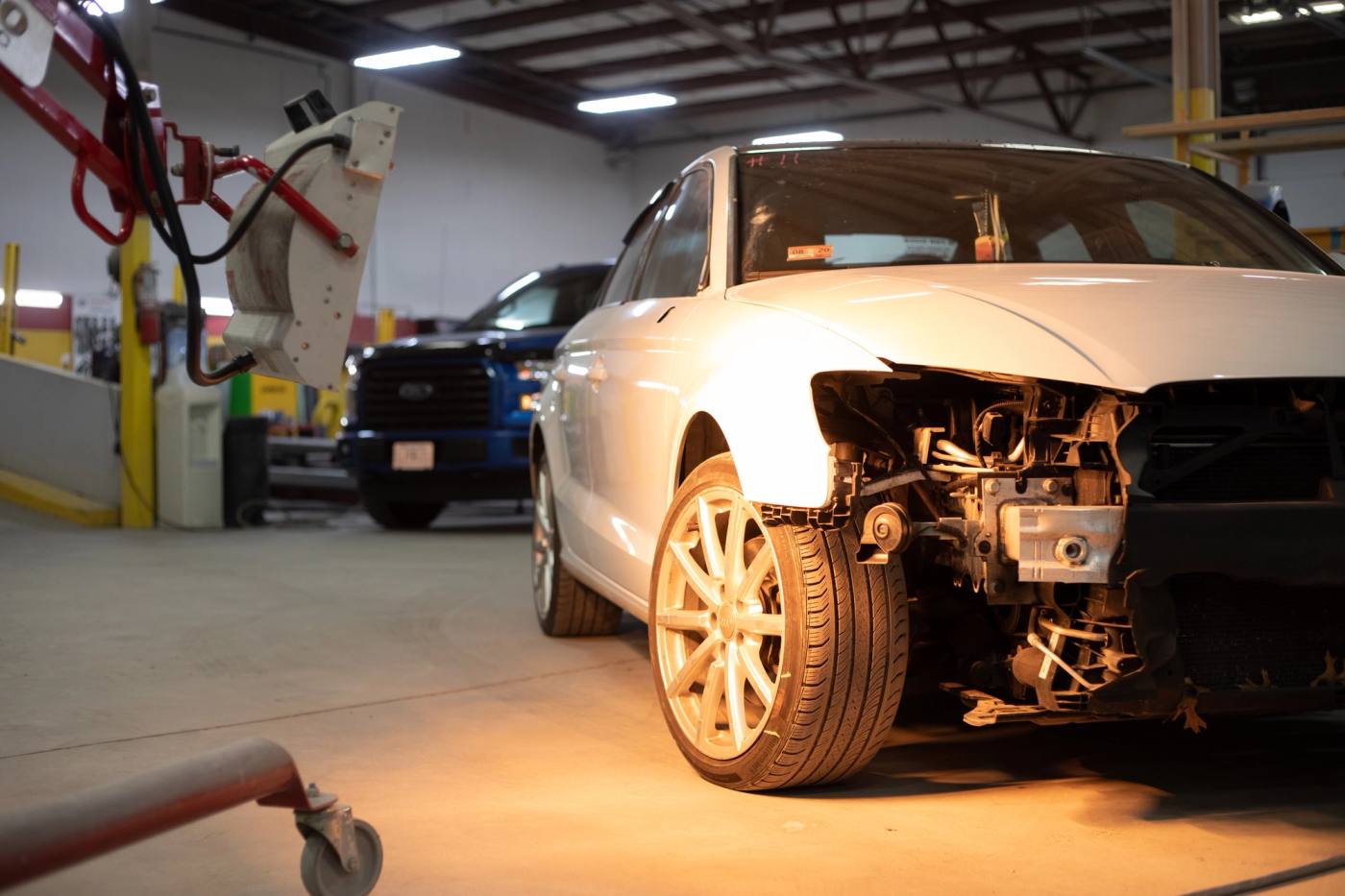
OEM parts are made by or for the company that built your car, to the exact factory spec. Aftermarket parts are made by other companies to fit it. For a low-stakes cosmetic piece, a good aftermarket part can be fine, but for anything structural, anything tied to a sensor, or anything that has to perform in a crash, we lean OEM, and we'll tell you why on your specific repair.
What does OEM actually mean?
OEM stands for original equipment manufacturer. It's the part that came on the car from the factory, or one built to that same blueprint and stamped with the carmaker's blessing.
Here's a real example. Say you bring in a 2019 silver Camry with a crunched front fender. The OEM fender is the one Toyota engineered for that body: same steel gauge, same mounting points, same finish, same gap when it sits next to the hood. It bolts on like the same one when the car left the factory.
Aftermarket means a third-party reverse-engineered something to fit. Sometimes that company nailed it. Sometimes the holes are a hair off, and a tech is out in the shop massaging brackets to make a fender sit flush. That extra labor doesn’t always show up on the initial estimate, but the end-result is a longer repair process and a car that doesn’t look quite the same.
Are aftermarket parts safe?
Depends entirely on which part. That's the honest answer, and anyone who gives you a flat yes or no is selling something.
A plastic bumper cover on a fender-bender? An aftermarket one can be perfectly acceptable. A wheel-well liner, a piece of trim, and a non-structural splash shield are all low risk. Nobody's life rides on a splash shield.
Now flip it. A bumper reinforcement bar, a crush zone, a structural rail, an airbag sensor bracket. These are the parts engineered to fold a certain way and fire your safety systems at a certain millisecond. When a carmaker designs how a car absorbs a 35-mph hit, they're designing the OEM steel, not a copy of it. We're not going to gamble with your crumple zone to shave a few dollars off a supplement (a supplement is just an addition to the original estimate once we find more damage during teardown).
There's also the boring stuff that still matters. Fit and finish and corrosion. A lot of cheaper aftermarket body panels don't have the same factory coatings, so three winters of Route 24 brine and you've got rust blooming at a seam where the OEM panel would've held. We see it. Fall River winters don't go easy on anything.
Why do insurers push aftermarket parts?
Cost. Aftermarket parts are usually cheaper, and your insurer is trying to settle the claim for less, because that’s their job. Insurance companies want to save money, and the fact is that they are not experts at repairing vehicles back to factory conditions like we are.
Here's the part people don't realize. The list of parts on your estimate is a conversation, not a verdict. An insurer can specify aftermarket. You can ask for OEM. On a lot of repairs we land somewhere sensible, aftermarket on the cosmetic stuff and OEM where it counts, and we handle the back-and-forth and the direct billing so you're not stuck translating insurance shorthand on top of everything else you're already dealing with after a wreck. Sometimes that means a phone call documenting why a structural part needs to be OEM. We make that call.
And worth saying plainly: in both Massachusetts and Rhode Island, you pick the shop. Your insurer can suggest one, even nudge hard toward one. They can't make you go there. We wrote more about your right to choose your shop here. It's calmer than people expect once they know where they stand.
Does Massachusetts or Rhode Island require OEM parts?
Both states have rules here, and they don't work the same way. Rhode Island goes by the car's age. Massachusetts goes by mileage.
In Rhode Island, the line is 48 months from the build date. If your car is less than four years old, an insurer can't force aftermarket parts on you without your written okay, and a shop can't put non-OEM parts on the car without your written consent either. You're supposed to be given that choice in writing. From 48 to 72 months out, an insurer can't refuse OEM parts if you ask for them in writing. So on a newer car in Rhode Island, OEM is effectively your call, not the adjuster's. Glass is the one exception.
Massachusetts works off mileage instead. Under the current rules, on a car with roughly 20,000 miles or less, the appraisal is supposed to be written for new OEM parts rather than aftermarket or used, unless the car's pre-accident condition says otherwise. Past that mileage, an insurer can specify aftermarket or used parts, but two things still hold. The part has to be "like kind and quality," meaning equal to or better than what was on the car before the crash. And any non-OEM part must be clearly identified on your estimate. No slipping a used quarter panel onto the bill without it showing.
None of this is legal advice, and the fine print runs deeper than a blog post. The headline is what matters: on a newer or lower-mileage car, the rules lean toward OEM, and you have more say than most people use. Not sure where your car lands? Ask us. We read these estimates every day.
What about ADAS sensors and the cameras?
This is where the OEM question gets sharp, fast. Modern cars are loaded with ADAS, which is the catch-all for the cameras, radar, and sensors that run automatic braking, lane-keeping, and blind-spot warnings.
A lot of those sensors live behind the front bumper, in the windshield, tucked into mirrors and quarter panels, and their aim is measured in fractions of a degree. Bolt a slightly-off aftermarket bracket behind a radar sensor and the radar is now pointed at the wrong patch of road. The light on your dash might never come on. You'd never know until the day the car was supposed to brake and didn't.
That's why on a sensor-related repair we care a great deal about how the part mounts, and why we calibrate ADAS in-house after the work is done rather than sending the car somewhere else and hoping it comes back aimed right. If you want the longer version of why a 2024 anything is a fundamentally different repair job than a 2004 anything, we broke that down here.
When are OEM parts actually required?
On certain certified repairs, OEM parts and OEM procedures aren't a preference. They're the rule for the repair to count as done right.
Take a Tesla Model 3. To stay a Tesla-certified shop, you repair the car Tesla's way, with Tesla's parts and Tesla's procedures, with no aftermarket substitutions. The same spirit runs through a lot of our 20-plus manufacturer certifications, including Mercedes-Benz. The carmaker says: build it back to our blueprint or don't put our name on it. (We hold I-CAR Gold Class, the top training tier in this trade, which is partly about knowing exactly when those lines can't be crossed.) More on what that Tesla certification actually demands is over here.
So we're not anti-aftermarket. We use aftermarket parts every week, on the right repairs, and they save customers money without costing them anything that matters. The position we won't move off: when fit, corrosion, structure, or a safety sensor is on the line, OEM is the call. Your car only has to survive one bad day on the Braga Bridge for that to matter.
If you want a straight read on your own car before any of this comes up, send us photos through our free online photo estimate and we'll tell you what we'd put on it, OEM or not, and why.
Frequently asked questions
What's the difference between OEM and aftermarket parts?
OEM parts are made by or for your vehicle's manufacturer to factory specifications, so they match in fit, finish, and performance. Aftermarket parts are made by third-party companies to fit your car, and quality ranges from excellent to poor depending on the maker and the part.
Are aftermarket parts safe for collision repair?
For cosmetic, non-structural pieces like bumper covers and trim, a good aftermarket part can be perfectly safe. For structural components, crash-absorbing parts, and anything tied to ADAS safety sensors, OEM is the safer choice because those parts are engineered to exact factory tolerances.
Can my insurance company require aftermarket parts?
Your insurer can specify aftermarket parts to control cost, but you can ask for OEM, especially on structural or safety-related components. We handle that conversation with your insurer and document why a part should be OEM when it matters.
Do I have to use the body shop my insurance recommends?
No. In both Massachusetts and Rhode Island, you choose the repair shop. Your insurer can suggest one, but the decision is yours.
Are OEM parts always required on certified repairs?
On certain certified vehicles, yes. Tesla and other manufacturer-certified repairs require OEM parts and OEM procedures for the repair to meet the carmaker's standard, with no aftermarket substitution on structural and safety systems.
Do Massachusetts and Rhode Island require insurers to use OEM parts?
It depends on the car. In Rhode Island, if your vehicle is under 48 months old, an insurer can't make you take aftermarket parts without your written consent, and from 48 to 72 months they can't refuse OEM if you ask in writing. In Massachusetts, the rule runs on mileage: at roughly 20,000 miles or less the estimate should call for new OEM parts, and above that an insurer can specify aftermarket or used parts as long as they're equal quality and listed on your estimate.
