
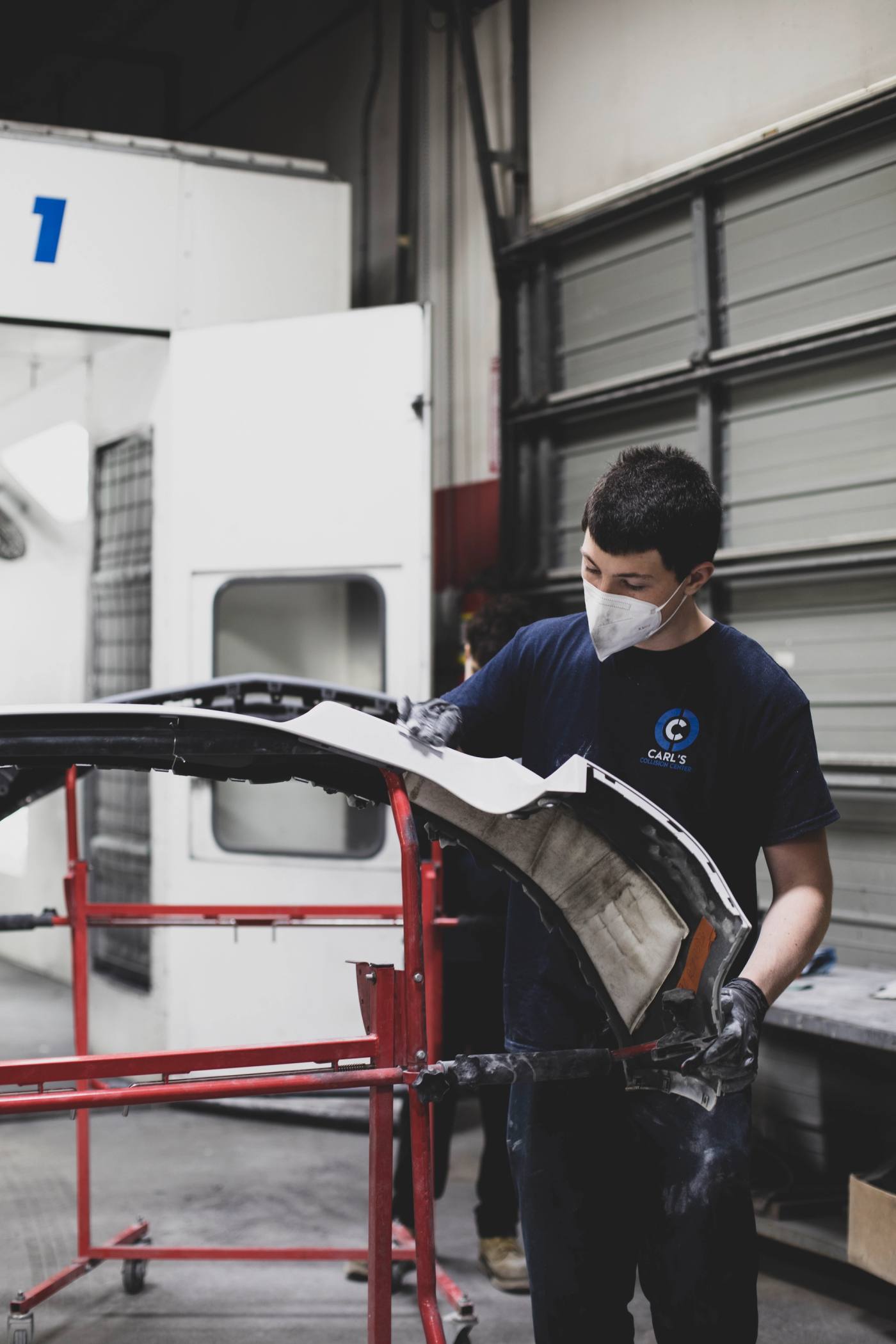
How long depends most on one thing people don't expect: whether insurance is paying. A small job you cover out of pocket, a scuffed bumper or a single panel, can be in and out in three to five business days. The same damage on an insurance claim often runs closer to two weeks. The repair work is identical. The difference is that we can't start a claim job until your carrier has inspected the car and signed off on the plan.
That's the honest version. Anyone who promises an exact pickup day before the car is taken apart is guessing.
Why does an insurance claim take longer than paying out of pocket?
Because of one step that out-of-pocket repairs skip entirely: approval.
On an insurance job, we don't begin the actual repair until your insurance company has inspected the vehicle and approved the repair procedures and the parts. That isn't us dragging our feet. It's how a claim works, and it protects you, because it makes sure the car gets fixed to the right standard and that the work gets paid for correctly. The catch is that the timing of that inspection and approval runs on the insurer's schedule, not ours. Plenty of carriers are quick about it. When an appraisal or a later approval takes a while to come back, though, that's usually where a one-week job turns into a two-week one. The car can be sitting in our shop, parts on hand, ready to go, while we wait on the green light to touch it.
We handle all of that back-and-forth for you, and we stay on the insurer to keep it moving. We just can't honestly promise a date we don't fully control.
Pay out of pocket and that whole step disappears. You approve the estimate, we order parts, we get to work. That's the real reason a customer-pay bumper can be done in a few days while the exact same bumper on a claim is closer to two weeks.
How long does the insurance company have to look at my car?
Both states put a clock on the insurer, which is worth knowing, because this is the part of the wait you can actually hold them to.
Massachusetts is specific about it. Once you report the claim, the insurer has two business days to assign an appraiser. That appraiser then has three business days to physically inspect the car. And the finished appraisal has to be sent within five business days of the assignment. Add it up and a written appraisal in your hands about a week after you report the claim is what the rules call for. There's room for reasonable delays, a snowstorm or a car nobody can get to, but the deadlines are real.
Rhode Island runs it differently. There's no fixed number of days for that first visit. The appraiser has to schedule it promptly, and once they've actually inspected the car, the appraisal has to be left at the shop or delivered within 24 hours. If we open the car up and find more damage, the appraiser then has four business days to come back out and re-inspect for the supplement. Rhode Island also says you don't have to haul the car somewhere else to be looked at if it can be appraised right here at our shop.
Why does this matter to you? When the insurer hits those marks, a claim repair moves about as fast as a paying job once the parts land. When an appraisal or a supplement runs past them, that's usually the holdup, and now you know what the timeline is supposed to be. We track these dates on every claim and stay on the adjuster when one starts to slip.
What's a realistic timeline for my repair?
Set the clock by two things: how bad the damage is, and whether insurance is in the picture.
Small cosmetic work you're paying for yourself, a bumper and a little paint, is often three to five business days. Put that same job on a claim and you're usually looking at one to two weeks, most of it approval and parts. A bigger hit, a fender and a door with a respray, runs a week or two of real work on top of whatever the approval adds. Then there's heavy damage, the kind that pushes a quarter panel in or bends a frame rail. Structural repair means measuring the body, pulling it back to factory spec, replacing panels, painting, and recalibrating the safety electronics, and that can stretch past three or four weeks once parts and approvals are counted.
What else slows things down?
After the insurance approval, a few things drive the clock, and only one of them is the actual wrenching.
Parts are the sneaky one. A common bumper for a 2019 Camry might already be on a shelf in a regional warehouse. A panel for a newer Tesla Model 3, or anything on national backorder, can park your car for days while everyone waits on a truck. We can't paint a panel we don't have yet.
Hidden damage is the other big one. When we pull a bumper and find a cracked bracket or a bent reinforcement behind it, that becomes a supplement, which is just a follow-up estimate. On a claim it goes back to the carrier for another round of approval before those parts move, so it's one more wait. It isn't padding. A crash bends metal you can't see from the curb, and we'd rather find it on the lift than hand you back a hidden problem. The full drop-off-to-pickup picture, teardown and all, is in the collision repair process explained.
Then the modern stuff. Newer cars are loaded with cameras and radar that run lane-keep, automatic braking, and blind-spot alerts, known together as ADAS (advanced driver-assistance systems). After a collision those have to be recalibrated so they aim exactly where the factory set them. We do that in-house, which saves the days you'd lose shipping the car out, but it's still a real step. (Here's why a newer car is a different repair job.)
And paint. Color gets matched, sprayed, and given time to cure. You can't rush chemistry.
Same bumper, two very different timelines
Picture one scuffed rear bumper and two customers.
The first is paying out of pocket. We write the estimate, she says go, the cover and a clip are on hand, and between paint and a quick sensor recalibration she's back in her car in about four days.
The second is going through insurance for the identical damage. We write the estimate and send it over, then wait for the adjuster to inspect and approve it. Parts get ordered after that approval, not before. Partway in we find a cracked bracket and file a supplement, which goes back for another sign-off. Same bumper, same crew, same building. He's closer to two weeks. The work didn't change. The approvals did.
What can I do to speed it up?
A few things actually help.
Answer fast. When your insurer sends you something to approve, a same-day yes can pull days off the back end.
Start before you even drop off. Send photos through our free photo-estimate tool and we can size up the damage and get ahead on planning the repair process before the car arrives.
If you're paying out of pocket for something small, say so up front. Skipping the claim cycle is the single biggest time-saver there is, and a lot of people don't realize it's an option for a minor repair.
And keep your phone on you. Approvals, color confirmations, parts questions: the faster we can reach you, the faster the car moves.
Frequently asked questions
Why is my insurance repair taking more than a week?
Most of the wait is approval. On a claim, we can't start until your insurer inspects the car and signs off on the repair, and any supplement for hidden damage needs its own approval. The repair work itself is often the quick part.
How long does a bumper repair take?
Paying out of pocket, a cosmetic bumper with paint could be three to five business days when parts are on hand. Through insurance, count on closer to two weeks once the inspection, the approval, and any supplement are added in.
Is the delay the shop's fault or the insurance company's?
A lot of the wait is the approval cycle, which runs on the insurer's schedule, not ours. We handle the back-and-forth and push to keep it moving, but we won't start cutting into a claim repair before it's approved.
What is a supplement, and does it delay my repair?
A supplement is a follow-up estimate for damage we couldn't see until the car was apart. On an insurance job it needs another approval before those parts move, so it can add a few days. It's a normal part of fixing a crash.
Can I get a rental while my car is in the shop?
Yes. We keep rentals available on-site, so you're not stranded while we work.
How long does the insurance company have to inspect my car after an accident?
In Massachusetts, the insurer has two business days to assign an appraiser, the appraiser has three business days to inspect the car, and the finished appraisal must go out within five business days of the assignment. Rhode Island doesn't set a day count for the first visit but requires the appraisal within 24 hours of the inspection, and a re-inspection for supplements within four business days. Both states allow reasonable delays for things like weather.
